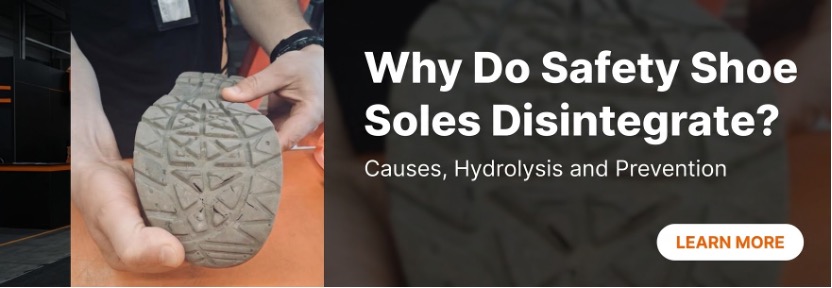
A safety shoe can look almost new and still have a sole that suddenly cracks, crumbles or falls apart. This can be especially surprising when the shoes have been worn only a few times or have spent most of their life in storage.
So, why do safety shoe soles disintegrate?
One of the most common causes is material ageing, particularly hydrolysis in polyurethane (PU) soles. However, sole deterioration can also be influenced by storage conditions, temperature, humidity, mechanical stress, material formulation and manufacturing processes.
Understanding these factors is important because once a sole loses its physical integrity, the footwear may no longer provide the protection and performance it was designed to deliver.
What Causes Safety Shoe Soles to Disintegrate?
Common causes of sole deterioration include:
- Hydrolysis of polyurethane (PU)
- Prolonged exposure to heat and high humidity
- Improper storage conditions
- Long periods of inactivity
- Natural ageing of polymer materials
- Repeated flexing, impact and abrasion
- Material or manufacturing factors
Among these, PU sole hydrolysis is one of the most important causes of crumbling safety shoe soles.
What Is PU Sole Hydrolysis?
Hydrolysis is a chemical degradation process in which moisture gradually breaks down the polymer structure of certain polyurethane materials.
As the PU structure deteriorates, the sole can lose flexibility, strength and elasticity. In advanced stages, it may become brittle and begin to crack, crumble or disintegrate.
Heat and high humidity can accelerate this ageing process, which is why PU sole deterioration can be particularly relevant in warm and humid environments.
Why Is PU Used in Safety Shoes?
PU is widely used in safety footwear because it offers a useful balance of:
- Lightweight construction
- Flexibility
- Shock absorption
- Abrasion resistance
- Slip resistance
- Comfort
These properties make PU suitable for safety footwear where protection needs to be balanced with weight and long-term wearing comfort.
However, its ageing behavior must also be considered when selecting materials and designing the sole.
How We Approach PU Sole Durability at Charming Ever
At Charming Ever, we do not look at PU simply as a lightweight sole material. We consider how the material is expected to perform throughout the product's intended service life.
For PU safety footwear, our teams consider:
- PU formulation and raw material selection
- Hydrolysis resistance
- Sole density and hardness
- Flexibility and abrasion resistance
- Sole geometry and tread design
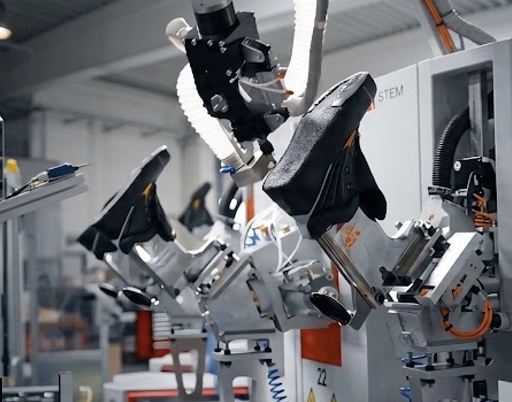
- Injection and processing conditions
- Working environment and expected exposure
This approach allows us to balance weight, comfort, durability and protection according to the intended application.
A PU sole's performance is determined by more than the material name on a specification sheet. Material selection, formulation and manufacturing process work together to determine how a sole performs over time.
Is Sole Disintegration Always a Manufacturing Defect?
Not necessarily.
A crumbling sole can result from natural material ageing, environmental exposure or storage conditions, rather than an original manufacturing defect.
At the same time, manufacturing quality remains important because material selection, processing and construction can influence the durability and ageing performance of the finished sole.
When investigating sole failure, a professional assessment may consider:
- Product age and production date
- Sole material and formulation
- Storage conditions
- Usage history
- Environmental exposure
- Failure pattern
- Manufacturing and inspection records
The visible failure is only the symptom. Identifying the root cause is what matters.
How Can Safety Shoe Sole Disintegration Be Prevented?
Natural material ageing cannot be completely eliminated, but proper material selection, manufacturing control and storage can help extend footwear service life.
For Manufacturers
Prevention begins during product development:
Appropriate material selection
Select materials and formulations according to the intended working environment and performance requirements.
Controlled manufacturing
Consistent mixing, moulding, injection and processing conditions are important for stable sole performance.
Testing and quality control
Material and product testing, together with quality control throughout production, helps identify potential issues before products reach the market.
For Users and Buyers
Good storage and maintenance practices can also help:
- Store footwear in a dry, cool and well-ventilated environment.
- Allow wet footwear to dry naturally before storage.
- Remove mud and contaminants after use.
- Avoid prolonged exposure to excessive heat and humidity.
- Rotate stored stock where appropriate.
- Inspect older footwear before use.
Most importantly, replace footwear when the sole shows significant cracking, crumbling, separation or other signs that its protective performance may have been compromised.
How Long Do Safety Shoe Soles Last?
There is no universal service-life period for every safety shoe.
The usable life depends on the sole material, construction, manufacturing quality, storage conditions, working environment and frequency of use.
A pair used daily in a demanding industrial environment will experience very different conditions from one stored for long periods in a humid warehouse.
Rather than relying on a fixed number of years, footwear should be assessed based on its age, condition, environment and remaining protective performance.
Charming Ever builds safety into every step
At Charming Ever, we look beyond the visible defect. Our Quality Control team consider materials, construction, manufacturing processes and real working conditions when developing and evaluating safety footwear.
Because reliable safety footwear is not only about meeting a standard. It is about understanding how materials perform over time and developing footwear that remains dependable throughout its intended service life.
Questions About PU Sole Hydrolysis?
If you have questions about PU sole hydrolysis, crumbling safety shoe soles or sole durability, our team is here to help. Contact sales@charmingent.com to discuss your requirements and learn more about safety footwear materials and performance.